|
Jonathan Sauder I'm a postdoctoral fellow at MIT CSAIL in Sara Beery's lab, where I work at the intersection of AI and ecology. My fellowship is supported by the Swiss National Science Foundation. During my PhD at EPFL at the intersection of machine learning and 3D computer vision, I created tools to monitor coral reefs at unprecedented scale. My PhD was embedded in the Transnational Red Sea Center, where I was co-supervised by Devis Tuia and Anders Meibom. Before that, I obtained my master's degree in computer science at TU Berlin, where I worked on research in machine learning, signal processing, and compressed sensing.Bio / Scholar / Linkedin / sauder@mit.edu |

|
Research |
|
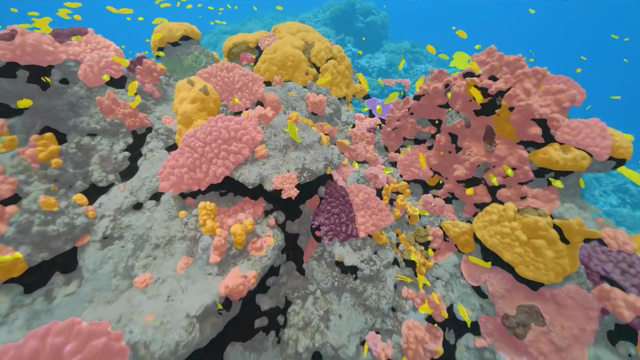
CoralscapesV2: Panoptic and Fine-Grained Visual Scene Understanding in Coral Reefs
Jonathan Sauder, Thomas Ruckli, Gabrielė Strodomskytė, Ibrahim Souleiman Abdallah, Rahma Hassan Abdi, Djama Goumaneh Awaleh, Mohamed Houssein Farah, Moustapha Nour, Osama Sharhubil Saad, Mustafa Mohammed Khalafallah Altaib, Maysoon Kteifan, Farah Alsoqi, Eyad Zgool, Jafar Al-Omari, Temesgen Gebremeskel Gebreluel, Zekaria Zekeria Abdulkerim, Meron Ghirmay, Teklehaimanot Beraki, Devis Tuia, Guilhem Banc-Prandi ECCV Workshop on Marine Vision, 2026 Project Page / ArXiv / Dataset The first panoptic segmentation dataset for coral reefs, extending Coralscapes to 95 fine-grained classes and 65k exhaustive, video-annotated fish instance masks. |
|
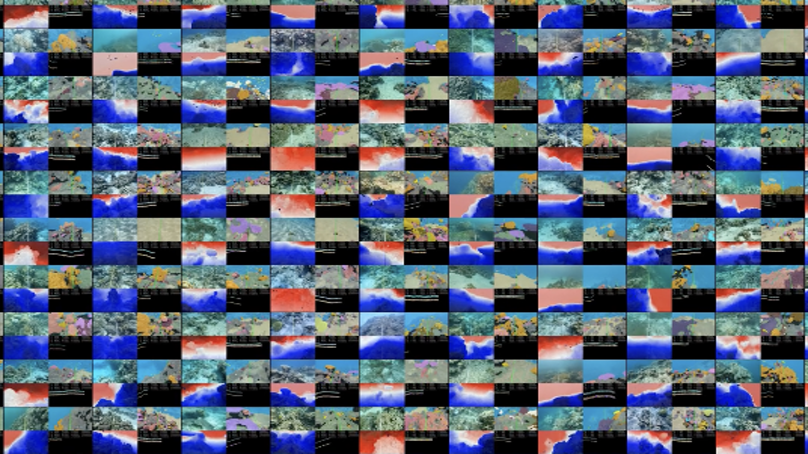
Rapid consistent reef surveys with DeepReefMap
Jonathan Sauder, Guilhem Banc-Prandi, Gabriela Perna, Ibrahim Souleiman Abdallah, Osama S. Saad, Mustafa Altaib Mohammed, Ali Al-Sawalmih, Anders Meibom, Devis Tuia Scientific Reports, 2025 The first fully AI-based transnational surveying endeavour, corroborating the real-world consistency of DeepReefMap and its robustness against environmental conditions. |
|
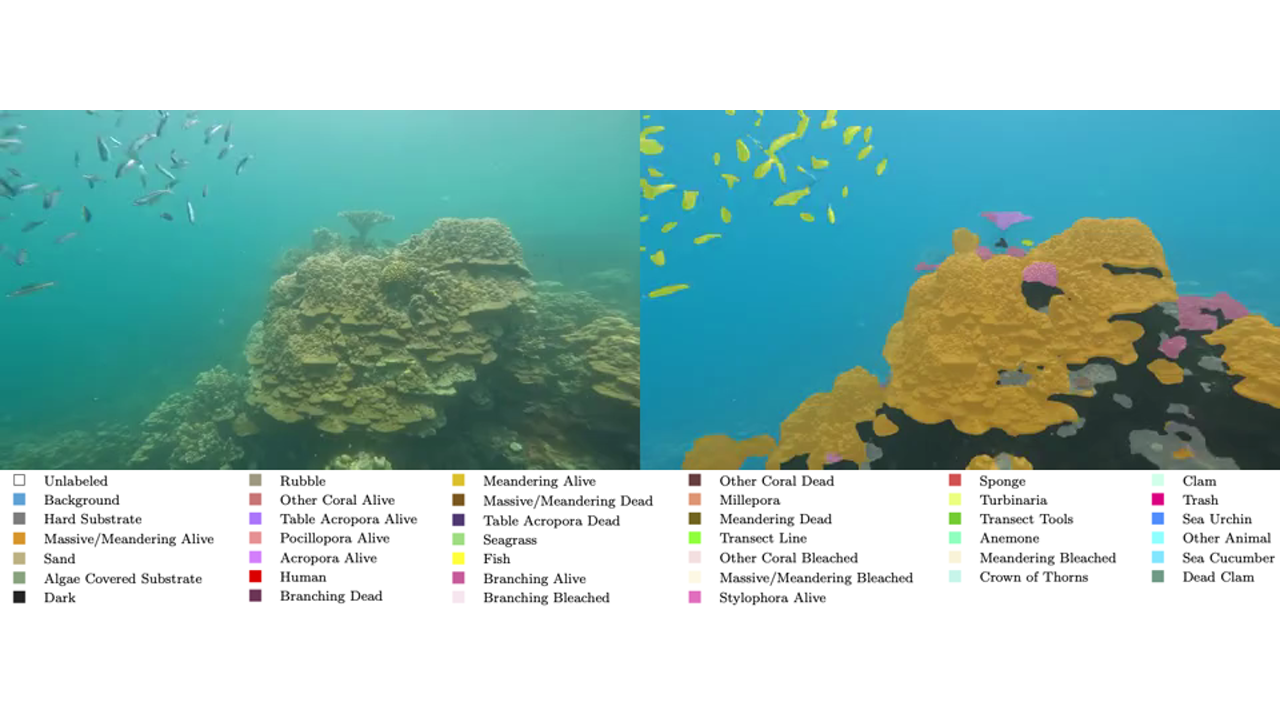
The Coralscapes Dataset: Semantic Scene Understanding in Coral Reefs
Jonathan Sauder, Viktor Domazetoski, Guilhem Banc-Prandi, Gabriela Perna, Anders Meibom, Devis Tuia ICCV Joint Workshop on Marine Vision (Best Paper Award), 2025 Project Page / ArXiv The first large-scale dense semantic segmentation dataset in coral reefs. |
|
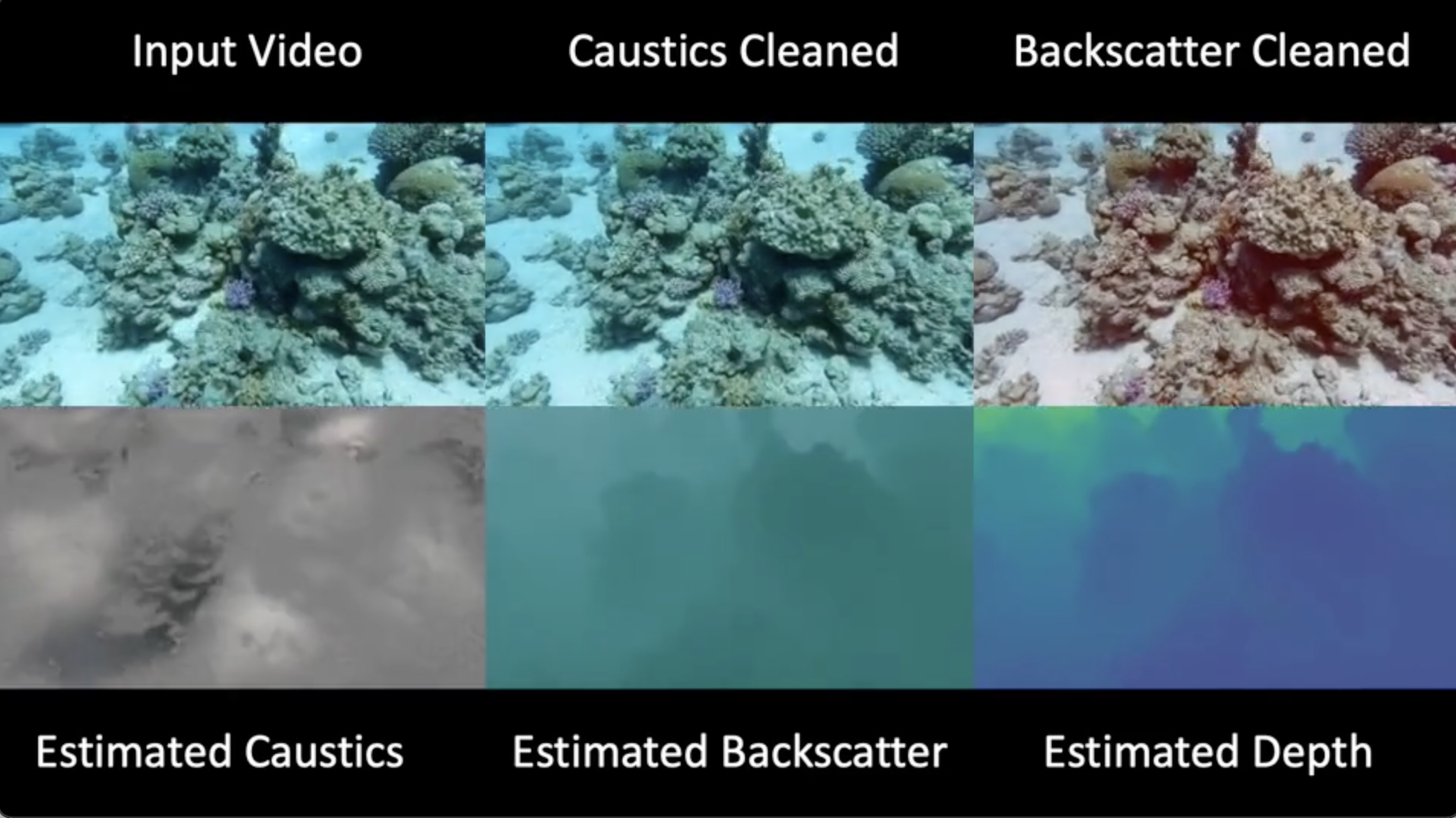
Self-Supervised Underwater Caustics Removal and Descattering via Deep
Monocular SLAM
Jonathan Sauder, Devis Tuia ECCV, 2024 Project Page / Paper Undo the degrading effects of the water column and noise patterns from sunlight on water surface by using self-supervised monocular SLAM to devise effective learning objectives. |
|
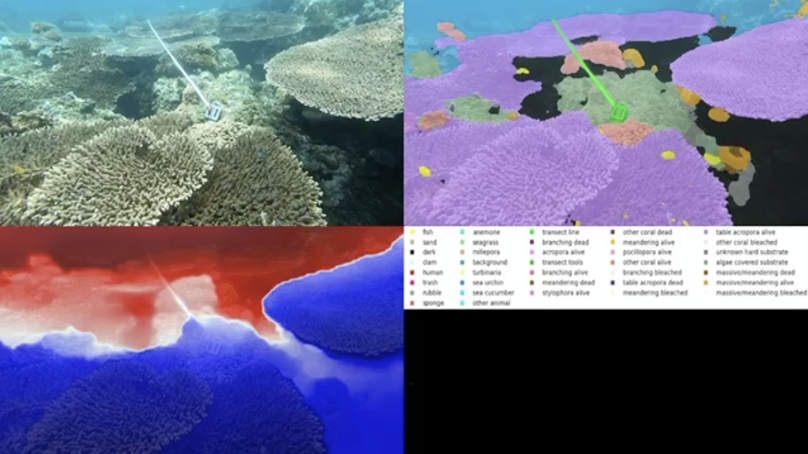
DeepReefMap:
Scalable Semantic 3D Mapping of Coral Reefs with Deep Learning
Jonathan Sauder, Guilhem Banc-Prandi, Anders Meibom, Devis Tuia Methods in Ecology and Evolution, 2023 Project Page / ArXiv / Wiley Self-supervised deep SLAM is combined with semantic segmentation on a new coral reef video dataset, creating a method for automatically analyzing video transects of reefs at unprecedented speed and cost-efficiency. |
|
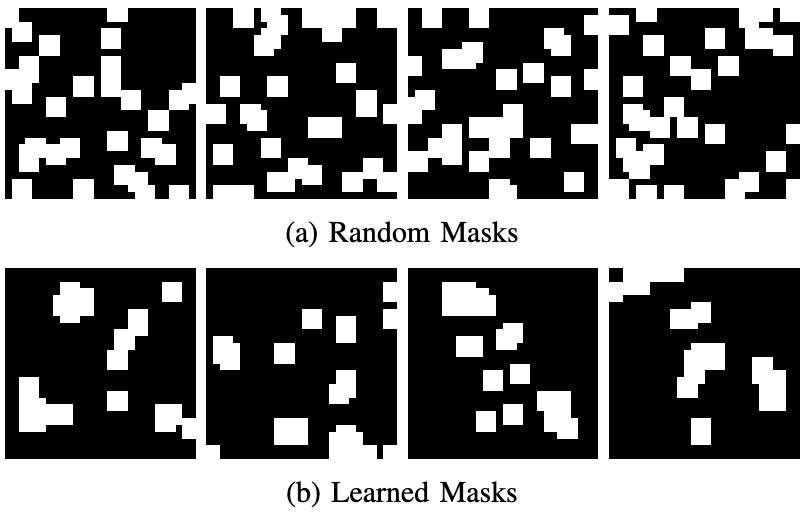
Gradient-Based Learning of Discrete Structured Measurement Operators for
Signal Recovery
Jonathan Sauder, Martin Genzel, Peter Jung IEEE Journal on Selected Areas in Information Theory: Deep Learning Methods for Inverse Problems, 2022 ArXiv / Paper Combining unrolled compressed sensing techniques with Gumbel-top-K allows learning compressed sensing matrices that follow imposed structure by real-world applications. |
|
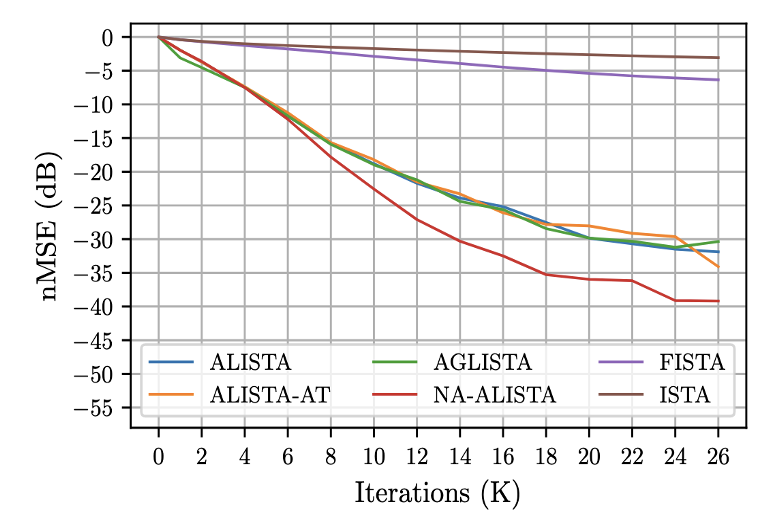
Neurally Augmented ALISTA
Freya Behrens, Jonathan Sauder, Peter Jung ICLR, 2021 GitHub / OpenReview / Paper A tiny LSTM component in unrolled compressed sensing for sparse signal reconstruction can significantly push the phase transition, with insights on how the LSTM chooses the optimal reconstruction thresholds and steps. |
|
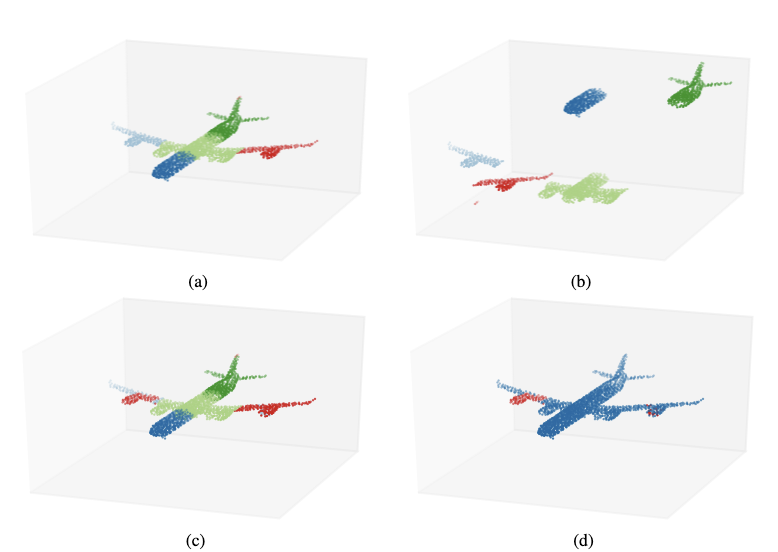
Self-supervised deep learning on point clouds by reconstructing
space
Jonathan Sauder, Bjarne Sievers NeurIPS, 2019 Paper One of the first approaches to do self-supervised learning directly on point cloud data, learning to undo masking and reshuffling. |
The Transnational Red Sea Center |
|
This website uses Jon Barron's temaple. |